Quick Look:
Traceability lets a food business isolate risk quickly, prove where a product came from, and show where it went next. This guide explains why that matters for food safety and recalls, FSMA 204 compliance, operational efficiency, and customer trust, where traceability breaks down today, and how to start a traceability program with a mock recall.
Traceability is important because it helps a food business isolate risk fast, prove where a product came from, and show exactly where it went next. That one capability affects recalls, FDA record requests, supplier disputes, customer confidence, and daily operations.
Without traceability, teams widen recalls, hold more inventory than necessary, and spend hours stitching together spreadsheets, emails, and paper logs. With traceability, they can answer direct questions quickly, contain the issue to the right lots, and keep safe product moving.
For supply chain, food safety, and operations leaders, that makes traceability more than a compliance task. It is a system decision that shapes recall readiness, operational efficiency, and buyer trust.
This guide answers why traceability is important, how it supports FSMA 204, where programs usually break, and what a practical modern system should include.
What food traceability means
Food traceability is the ability to follow a product and its ingredients across each step of the supply chain, from farm and first handling through processing, shipping, and final delivery. In simple terms, it gives teams two answers on demand: where this lot came from, and where this lot went.
That is different from basic tracking. Tracking shows the current location of a shipment. Traceability keeps a searchable history of lots, transformations, handoffs, and records, so a company can investigate an issue weeks or months later with evidence instead of guesswork.
Strong traceability depends on consistent lot identity, clean event records, and connected data across partners. Once one supplier changes labels, one plant records transformations loosely, or one site keeps critical data outside the system, the chain becomes harder to defend during a recall or audit.
Why it matters for recalls
Traceability matters most when something goes wrong. It reduces the time between detecting a risk and taking action, and it helps teams remove only the affected lots instead of treating the entire product line as suspect.
That is also how regulators describe the benefit. The FDA says its Food Traceability Final Rule is meant to support faster identification and removal of potentially contaminated food, and its rule materials point to more targeted recalls and less unnecessary food waste.
The cost of a broad food recall
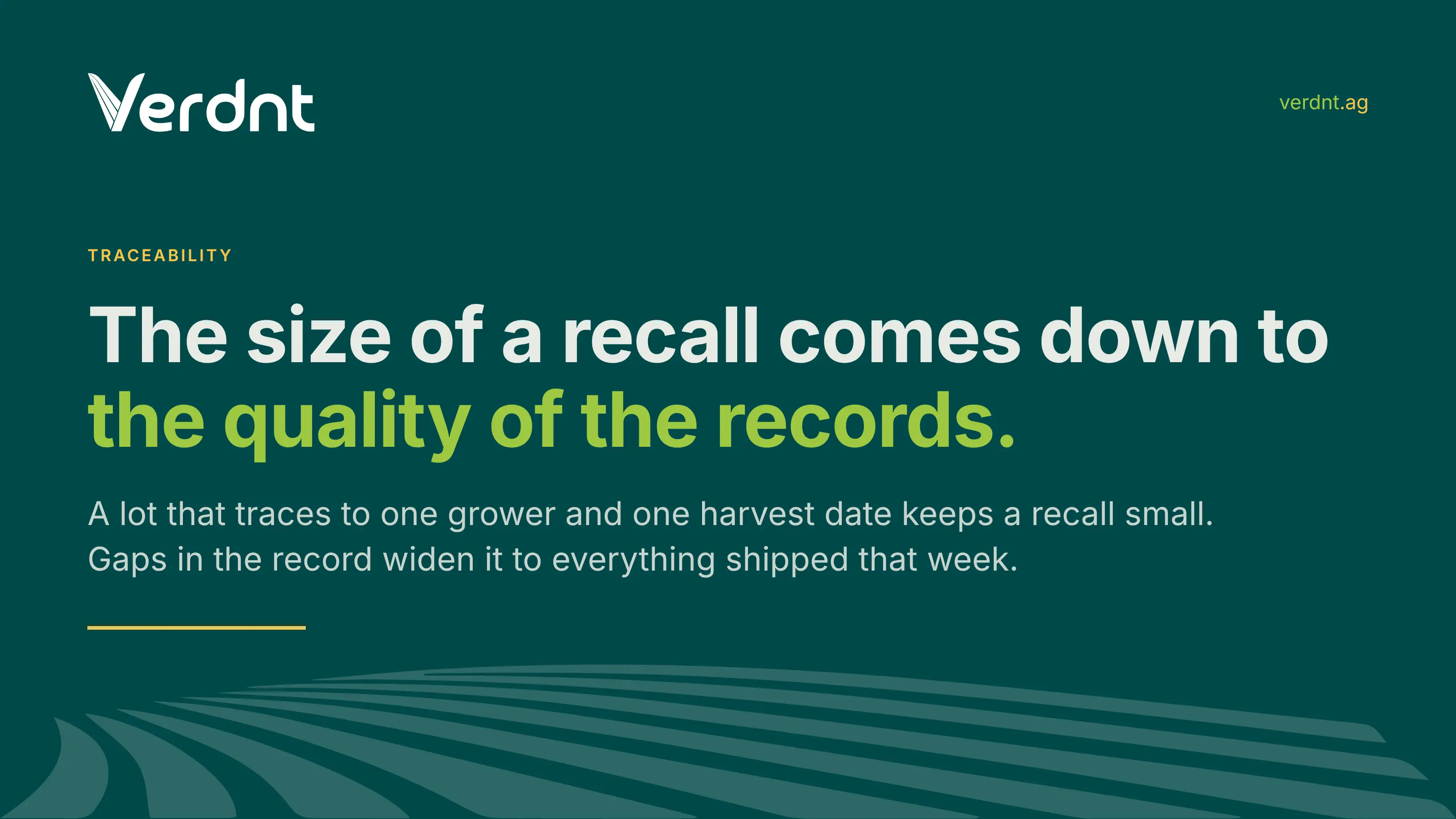
When lot-level links are weak, recall scope grows fast. A processor that cannot prove which ingredient lots fed which finished batches usually has to widen the action to protect consumers and satisfy customers. That pulls safe inventory off shelves, increases write-offs, and creates reputational damage that outlasts the incident itself.
Irish food safety guidance reaches the same conclusion, explaining that effective traceability reduces the scope and duration of recalls and limits financial and reputational impact.
The practical difference is simple. One business can isolate four batches in the same afternoon because its receiving, production, and shipping records are connected. Another spends two days reconciling paper logs and spreadsheets, then recalls weeks of output because no one can prove what was touched. That is the core business risk traceability is meant to reduce.
Outbreak response and public health
Traceability also speeds source identification during outbreaks. Investigators work backward across farms, aggregators, processors, and distributors to find the common point of contamination. Faster lot history means faster containment, fewer exposed consumers, and a shorter path to corrective action.
How traceability supports FSMA 204 compliance
For companies that sell into the United States, traceability is also tied to compliance. FSMA 204 requires additional recordkeeping for foods on the Food Traceability List, including foods that contain a listed ingredient in the same form. In practice, that means businesses need traceability records that are structured, consistent, and easy to retrieve.
Simplify FSMA 204 Food Traceability
See how Verdnt can help your team manage FSMA 204 traceability requirements with greater visibility and confidence.
Key data elements and critical tracking events
FSMA 204 is built around critical tracking events, or CTEs, and key data elements, or KDEs. CTEs are the moments when something significant happens to the product. KDEs are the facts the business needs to record at that moment.
The FDA says covered firms need a traceability plan and KDEs for CTEs such as harvesting, cooling, initial packing, first land-based receiving, shipping, receiving, and transformation.
| Critical tracking event |
Who typically performs it |
Example record focus |
| Harvesting |
Grower |
Location, harvest date, lot code assigned |
| Cooling |
Grower or packer |
Cooling location and date |
| Initial packing |
Packer |
Packing date, lot code, product description |
| Shipping |
Any shipper |
Origin, destination, lot code, ship date |
| Receiving |
Any receiver |
Source, lot code, receipt date |
| Transformation |
Processor |
Input lots, new lot code, output product |
In plain terms, traceability supports FSMA 204 because it makes required records available in the format regulators ask for, tied to the exact lots and events under review.
The 24-hour records requirement
The pressure point is retrieval speed. Firms must be able to provide the FDA electronic, sortable records within 24 hours of a request. That requirement does not force one specific technology, but it does expose weak processes quickly. Scanned documents, email trails, and site-level spreadsheets are hard to defend when the clock starts.
Where the compliance date stands
The original FSMA 204 compliance date was January 20, 2026. The FDA has proposed extending it to July 20, 2028. Records are generally kept for two years, so teams should still confirm the latest FDA position before locking internal timelines.
The proposed extension gives companies more runway, but it does not remove buyer pressure or implementation effort. Large growers, processors, and brand owners still need time to standardize lot logic, align supplier data, and connect farm, plant, and shipment records in one auditable flow.
Traceability and operational efficiency
Traceability is not valuable only during a recall. When lot events are captured cleanly, the same data improves routine decisions across inventory, production, procurement, and customer service.
Inventory teams can see which lots are available, aging, blocked, or already committed. Quality teams can hold the exact product under review instead of freezing an entire category. Operations teams can trace yield loss, rework, or recurring defects back to a supplier, field, line, or shift faster than they can with disconnected records.
Supplier reviews also become more useful. With reliable receiving and transformation data, teams can compare rejection rates, complaint frequency, and delivery consistency by supplier and lot history, then act on evidence instead of anecdote. Complaint investigations move faster for the same reason.
The stronger business case is that the same traceability layer can support compliance and everyday execution, rather than sitting off to the side as a recall-only process.
Manage Better. Track Everything.
Verdnt brings farm management and traceability together in one platform, giving your team the visibility and data needed to manage operations with confidence.
Brand trust and customer requirements
Traceability also supports the commercial side of the business. Retailers, foodservice buyers, and enterprise customers often expect suppliers to show origin, lot history, and handling records when questions come up. That expectation extends beyond food safety teams to procurement, compliance, and sustainability stakeholders.
When a supplier can respond with clear lot-level evidence, conversations move faster because the facts are easier to verify. When it cannot, the buyer is left with more uncertainty and may ask for extra reporting, extra checks, or a broader explanation of risk exposure.
The same applies during recalls. Precise customer communication, including affected lots, dates, and shipment paths, shows control. Broad, unclear messaging makes the event look larger than it may be.
Where traceability breaks down today
Many companies can trace one step back and one step forward on paper, but that is not the same as having a recall-ready system. The weak points are usually predictable.
One common gap is the distance between basic recordkeeping and end-to-end traceability. A business may know who sent a shipment and who received it, yet still struggle to connect input lots to transformed output, or to connect farm records to finished goods. That difference only becomes obvious during a mock recall, customer complaint, or FDA request.
Records often sit across spreadsheets, PDFs, supplier emails, and local plant files. That slows search, creates naming inconsistencies, and makes lot history harder to trust under pressure.
Supplier inputs are another break point. Upstream growers, packers, and aggregators may send incomplete or inconsistent data, which means downstream processors inherit the gap.
Farm-level data is frequently disconnected from enterprise workflows. Since harvesting and cooling are CTEs under FSMA 204, this matters early in the chain. Linking field, harvest, and input records to downstream lots is where connected farm management software becomes useful.
Transformation is the other common failure point. Once ingredients are mixed, repacked, split, or relabeled, the business needs a clean record of which input lots became which output lots.
That is one reason many teams evaluating a new system also compare broader best food traceability software options before choosing their architecture.
What a modern food traceability system needs
A modern food traceability system should not just store records. It should help teams capture the right data once, connect it across the chain, and retrieve it quickly in a usable format.
Core capabilities
The foundation is event capture. Teams should be able to record KDEs at each CTE through mobile workflows, barcode scans, partner uploads, or integrations, rather than reconstructing events later.
The system should preserve lot identity through receiving, transformation, and shipping, then let users search by lot, supplier, facility, date, or customer and see the upstream and downstream path without manual reconciliation.
Governance and integration
The second layer is control. Role-based access, audit logs, and clear ownership help keep records defensible. Integrations with ERP, warehouse, procurement, and quality systems reduce rekeying and improve adoption. For plant-heavy operations, this overview of traceability software for food manufacturing is a useful comparison point.
Another useful test is whether the system can support a mock recall without manual cleanup. Teams should be able to pull the lot history, review the affected upstream and downstream records, and export a usable file quickly.
Where multi-entity visibility matters, a platform like Verdnt becomes compelling because it connects farm, supply chain, and sustainability data in the same operating environment instead of treating traceability as an isolated compliance module.
Turn Farm Data Into Sustainable Action
Track what happens across your operations and build a clearer picture of your environmental and production impact. Verdnt brings farm data and traceability together to support more sustainable decisions.
How to start a traceability program
Start with a mock recall and treat it like an operational test, not a documentation exercise. Choose one finished product, trace it back to input lots and forward to customers, and measure how long it takes to produce a defensible answer.
Then map which products fall on the Food Traceability List, which CTEs apply at each site, and where data is still being entered late or manually. Standardize lot logic across suppliers and facilities, pilot the workflow on one line or business unit, and rerun the mock recall after each phase. The key metric is simple: how quickly your team can retrieve the right lot history without cleanup work.
Conclusion and next steps
Traceability is important because it gives food businesses speed, precision, and proof. It narrows recalls, supports FSMA 204 readiness, improves operational control, and helps teams answer buyers and regulators with confidence.
A practical next step is to test your current process with a timed mock recall and identify where lot history breaks. If the gaps run across farms, suppliers, plants, and reporting teams, Verdnt is worth reviewing as a connected platform for traceability, farm operations, and sustainability data.

 Vinay NairNov 25, 2026