What Should a Traceability System Do at the Farm Level? 9 Must-Have Capabilities

Quick Look:
A farm-level traceability system has to record where a crop was grown, what was done to it, and when and how much was harvested, then carry that record to the lot that leaves the packhouse. This guide sets out the nine capabilities that make that possible, how they map to FSMA 204 and buyer requirements, where systems usually fall short, and the questions to ask a vendor before you sign.
A farm-level traceability system should map every farm and block, give each one a permanent identifier, record field activity and harvest against that identifier, validate each record at the point of capture, and link the harvest to the lot code created at packing. Without those links, farm level traceability stops at the receiving dock.
The pressure to get this right is now dated. Under the FDA's Food Traceability Rule, growers of foods on the Food Traceability List must keep a farm map showing the location and name of each field, with geographic coordinates, and harvest records naming the field and date (21 CFR Part 1, Subpart S). Retail buyers are already asking for the same data on every shipment.
What farm-level traceability means
Farm-level traceability is the ability to connect a finished product to the specific farm, field or block where it was grown, along with the practices, inputs and harvest event recorded there. It begins before the crop leaves the ground.
The distinction matters because a traceability system that starts at the packhouse inherits whatever the grower wrote on paper. A lot code assigned at initial packing can be perfectly managed downstream and still point back to a grower name and a rough date. That is enough to trace a lot to a supplier. It is rarely enough to narrow a recall to the block that caused it.
For a broader primer on how farm records fit into the rest of the chain, see our guide to supply chain traceability.
Nine capabilities a farm-level system needs
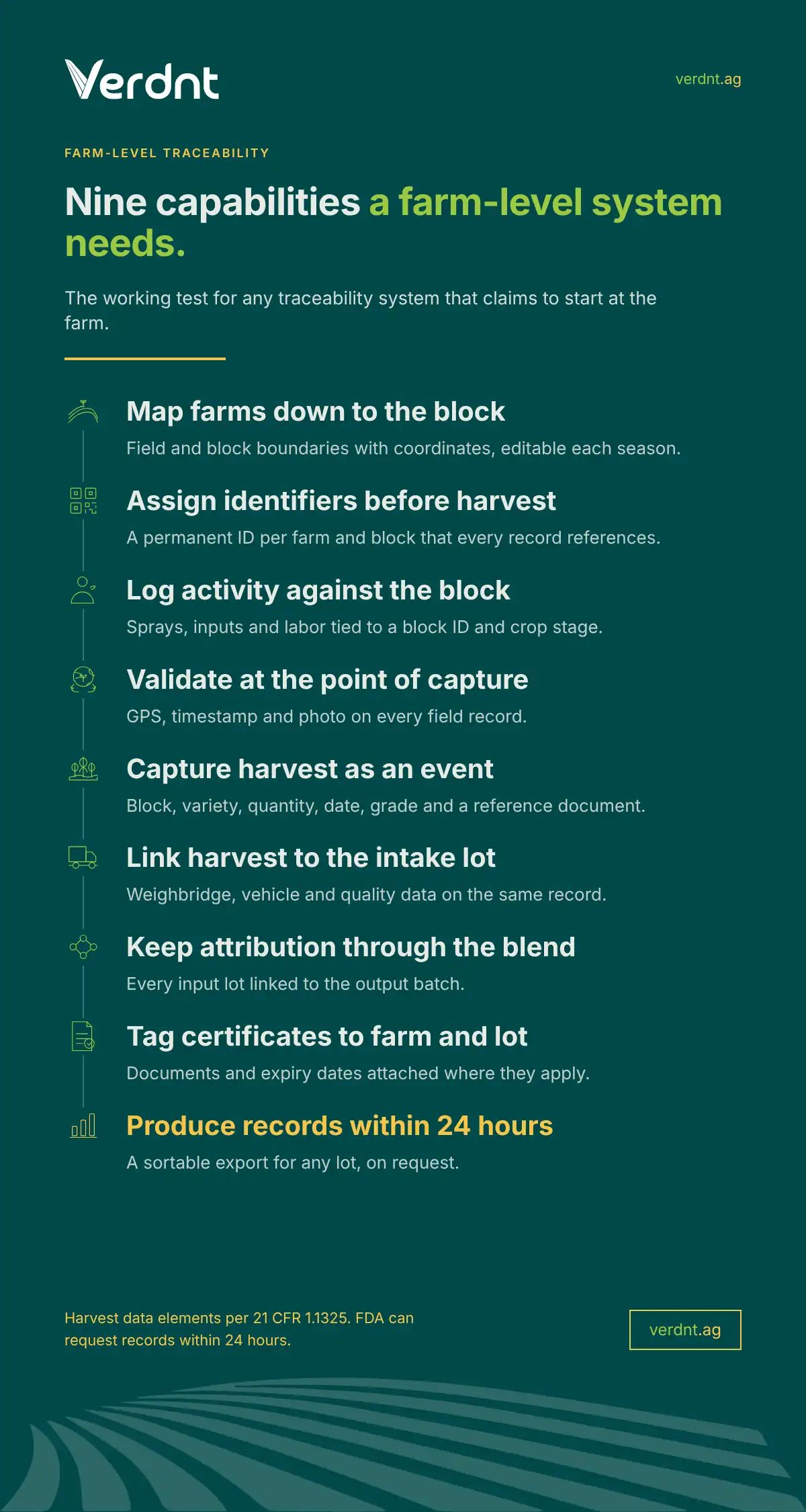
These nine capabilities are the working test. A system that covers all of them can answer a regulator, an auditor or a retail buyer from records it already holds.
1. Map farms down to the block
The system should hold a spatial map of every farm in the supply base, with field and block boundaries drawn, not just a farm address. FSMA 204 requires growers of listed foods to show each field or growing area with geographic coordinates in their traceability plan, so a polygon or coordinate set per block is the baseline.
Look for boundaries that can be edited season to season, because blocks are replanted, split and leased.
2. Assign identifiers before harvest
Each farm and each block needs a permanent identifier that every later record references. The identifier should exist before the first activity is logged, so spray, labor and harvest records attach to it from day one.
Systems that create the first identifier at the packhouse have nothing to attach field records to. That single design choice decides whether block-level data can exist at all.
3. Log activity against the block
Field activity (planting, spraying, fertilizing, irrigation, scouting) should be recorded against a block identifier and a crop stage. A spray record that says "north ranch, Tuesday" is far weaker in an audit than one tied to a block ID, a product, a rate and an applicator.
This is also where pre-harvest intervals and maximum residue limits get checked, so the record needs the product and the date in structured fields.
4. Validate records where they're captured
Every field record should carry a GPS location, a timestamp and, where it matters, a photo taken in the app. Validation at capture is what separates evidence from a reconstructed log.
Auditors and buyers increasingly ask how a record was created, not only what it says. A supervisor entering data on a phone in the block produces a record that holds up. A clerk typing up notes on Friday does not.
5. Capture harvest as an event
Harvest should be recorded as its own event with the block, commodity and variety, quantity and unit, date, and a reference document. Those are the key data elements FSMA 204 lists for the harvesting critical tracking event (21 CFR 1.1325).
Grading at harvest (for example A, B or C) is worth capturing here too, since quality decides which lots get blended later.
6. Link harvest lots at intake
When the harvest reaches the packhouse or collection point, the system should link the incoming harvest record to the lot created there. Weighbridge weights, vehicle details and quality checks at intake belong on the same record.
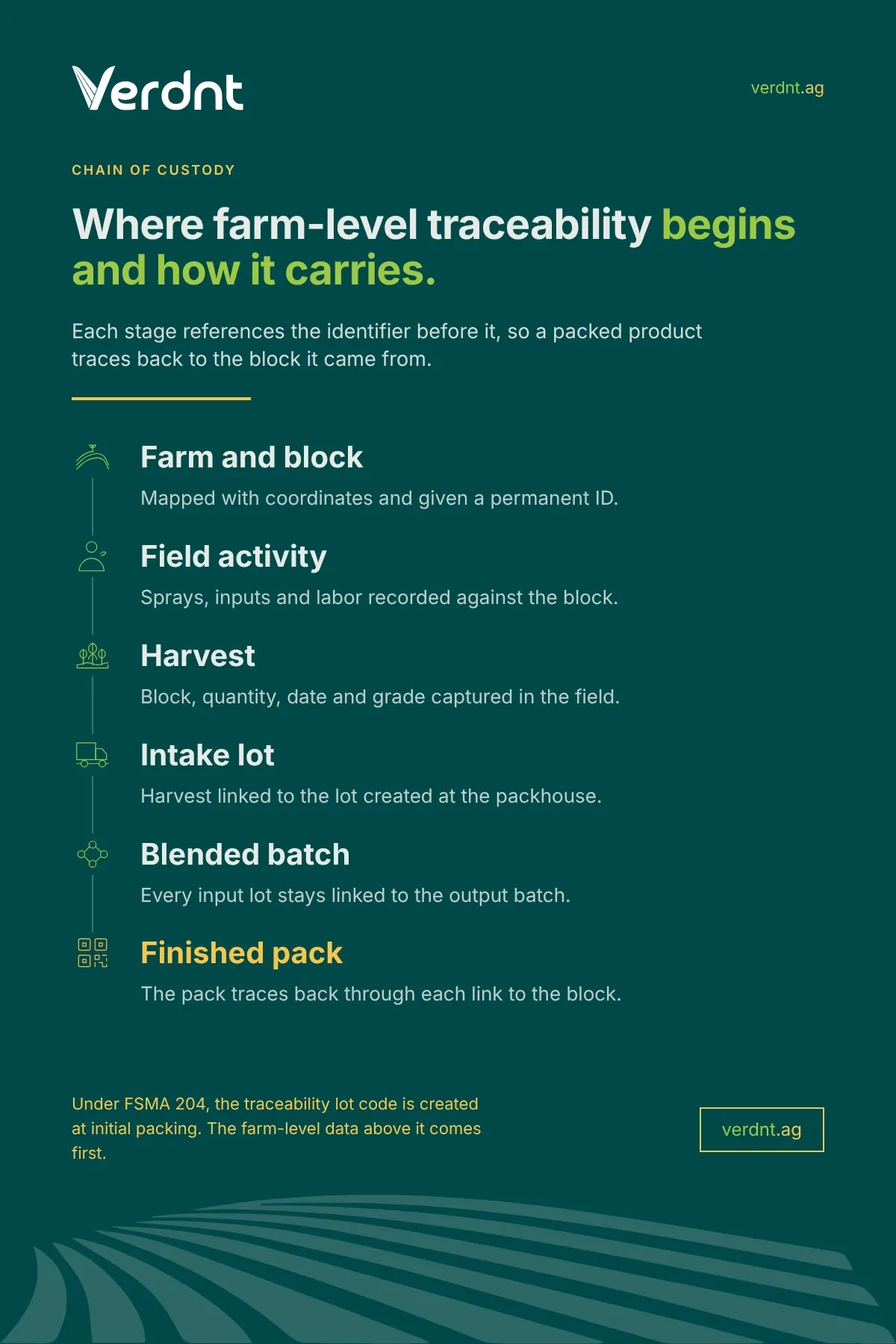
This is the handoff where most chains break. Under FSMA 204 the initial packer assigns the traceability lot code, so the packer needs the grower's harvest data in a form it can attach to that code without re-keying. Our guide to FSMA 204 covers who assigns lot codes and when.
7. Keep attribution through the blend
Fruit from many blocks goes into one bin, grain into one silo, juice into one tank. A farm-level system has to keep every input lot linked to the output batch, so the batch can still be traced to the blocks that fed it.
FSMA 204 treats commingling as a transformation event that requires the new lot code to be linked to every input lot code. Origin and sustainability claims depend on the same link. Without it, a recall has to cover everything the blend might contain.
8. Tag certificates to farm and lot
Certificates, residue test results and audit documents should be attached to the farm and the lots they cover, with an expiry date the system can flag. A GLOBALG.A.P. certificate stored in a shared drive cannot answer the question "was this lot covered on the day it shipped?"
9. Produce records within 24 hours
The system should export the farm, harvest and lot records for any product on request, in a sortable format, without a week of spreadsheet work. FDA can request traceability records with a 24-hour turnaround, and during an outbreak it can require an electronic sortable spreadsheet (FDA Food Traceability Rule).
Test this capability directly. A mock recall run on real data tells you more than any feature list.
Simplify FSMA 204 Food Traceability
See how Verdnt can help your team manage FSMA 204 traceability requirements with greater visibility and confidence.
How the capabilities map to requirements
The nine capabilities line up with what regulators and buyers ask for. This table shows the overlap.
| Capability | What it satisfies |
|---|---|
| Farm and block mapping | FSMA 204 farm map with geographic coordinates; EUDR plot geolocation |
| Block identifiers | Field or growing area name in harvest records |
| Activity logs | Certification audits, pre-harvest interval checks |
| Validation at capture | Auditor evidence for practice and sustainability claims |
| Harvest event | FSMA 204 harvesting key data elements |
| Intake linkage | Traceability lot code assigned at initial packing |
| Blend attribution | FSMA 204 transformation records; origin claims |
| Document tagging | Certification and buyer audits |
| 24-hour export | FDA records requests; retailer data requests |
Exporters to the EU face a parallel requirement. The EU Deforestation Regulation applies to large and medium operators from December 30, 2026 and requires geolocation of the plots where covered commodities were produced (European Commission). Block mapping built for FSMA 204 does double duty. See our EUDR compliance guide for the plot data the regulation expects.
Where farm-level systems fall short
Gaps tend to sit at the same three points, and each one can be checked in a demo.
The first is the identifier gap. The system starts at receiving, so farm data arrives as a grower name on a bill of lading. Ask the vendor where the first identifier is created.
The second is the commingling gap. The system splits lots well (one harvest into many cases) but loses the link when lots merge. Ask the vendor to show a blended batch traced back to individual blocks.
The third is the evidence gap. Field records exist, but they were typed in after the fact with no location, timestamp or photo. Ask how a record proves where and when it was created.
Getting growers to record at source
A farm-level system only works if growers and field supervisors use it. Adoption comes down to how much extra work the system asks of the people in the block.
Mobile capture tied to the crop stage helps, because the supervisor sees only the observations that matter that week. Forms should match the work being done, with dropdowns for products and blocks instead of free text. Growers also need a reason to participate. Faster payment against graded harvest records, or fewer audit requests, carries more weight than a compliance memo.
Roll out in stages. Start with the blocks that supply a single high-risk product, prove the record holds through one mock recall, then expand. Our guide to recall readiness covers how to run that test.
Questions to ask a traceability vendor
Use these questions to separate a farm-level system from a packhouse system with a grower directory attached.
- Where is the first identifier created: in the field, at harvest, or at receiving?
- Can a block boundary be mapped and edited, and does every field record reference it?
- Does each field record carry a GPS location, timestamp and photo from the device?
- Which harvest data elements are captured, and in which fields?
- How does a harvest record link to the lot code at intake without re-keying?
- Show a blended batch traced back to its source blocks.
- How are certificates tied to farms and lots, and are expiry dates flagged?
- How long does it take to export every record for one product lot?
- Can growers use it on a phone in the field, and what does onboarding involve?
For a fuller evaluation framework, see our guide to food traceability system requirements. Teams running many farms should also read our guide to crop management software for multiple farms and blocks.
Where to start
A traceability system earns the farm-level label when its first identifier is created in the field and every later record, from spray log to packed lot, points back to it. Everything else depends on that design choice.
Start by mapping one product line: list the blocks that feed it, check whether each harvest record names the block, and time how long it takes to trace one shipped lot back to its fields.
Verdnt is built for farm-dependent supply chains, with traceability that starts at the farm. Each farm and block gets an identifier before harvest, field activity is recorded on mobile with GPS, timestamp and image validation, and harvest, intake lot and batch records stay linked through blending. See how Verdnt traces a lot from the block to the pack, or book a demo and bring one of your own lots.
Discover a smarter way to manage farms, data, and traceability.
See how Verdnt can help you gain better visibility across your farm operations and make more informed decisions.
Frequently asked questions
What should a traceability system be able to do at the farm level?
A farm-level traceability system should map every farm and block, assign each a permanent identifier, record field activity and harvest against that identifier with GPS, timestamp and photo, link the harvest to the lot code created at packing, keep that link through blending, tag certificates to farms and lots, and export records for any lot within 24 hours.
What farm records does FSMA 204 require from growers?
Growers of foods on the FDA Food Traceability List must keep a farm map showing each field or growing area with geographic coordinates, and harvest records covering the commodity and variety, quantity, farm location, field name, harvest date and a reference document. FDA can request these records with a 24-hour turnaround. The compliance date is July 20, 2028.
Who assigns the traceability lot code, the grower or the packer?
Under FSMA 204, the traceability lot code is assigned at initial packing, so the packer usually creates it, not the grower. The grower provides harvest data such as the field, date and quantity, and the packer links that data to the lot code. A farm-level system makes that handoff possible without re-keying.
Can a blended product be traced back to the source farm?
Yes, when every input lot stays linked to the output batch at the point of blending. FSMA 204 treats commingling as a transformation event that requires the new lot code to reference every input lot code. Systems that only track lots splitting into cases lose source attribution when lots merge.
How do you get growers to record traceability data at source?
Keep the extra work small. Mobile capture tied to the crop stage, short forms with dropdowns for blocks and products, and a clear benefit to the grower, such as faster payment against graded harvest records, drive adoption. Roll out on one high-risk product first and prove it through a mock recall before expanding.
Written by
Founder and CEO - Verdnt
Vinay Nair is the Founder and CEO of Verdnt, an enterprise agri-tech SaaS platform that helps agricultural businesses integrate data from tractors, sensors, satellites, weather stations, and mobile applications. His experience building and scaling technology for the agriculture sector gives him first-hand expertise in agri-tech, farm data management, digital transformation, sustainability, and enterprise software. Vinay regularly shares insights on how data and AI can help agricultural businesses improve productivity, strengthen supply chain traceability, and make better operational decisions.