
What Is a Traceability Lot Code and When Do You Assign One?

Quick Look:
A traceability lot code (TLC) is the unique identifier that ties a food lot to every record created for it under FSMA 204. This guide explains the three moments you assign one, when you keep the same code, how the TLC source works, how to structure lot codes, and the common mistakes to avoid at enterprise scale.
A traceability lot code, or TLC, is the unique identifier that ties one food lot to every record created for it under FSMA 204. You assign a traceability lot code at three moments only: initial packing of a raw agricultural commodity, first land-based receiving of food from a fishing vessel, and transformation. In every other routine handoff, the existing code should stay with the product.
That is the short answer. The harder part is making sure the right facility owns the code, the format works across trading partners, and the record set can be pulled fast during a traceback or recall.
This guide explains what a traceability lot code is, when to assign one, when to keep the same one, and how to structure it so your team can respond within the 24-hour window tied to the FSMA 204 sortable spreadsheet requirement.
What a traceability lot code is
The FDA describes a traceability lot code as a descriptor, often alphanumeric, used to uniquely identify a traceability lot within the records of the firm that assigned it. A traceability lot is a batch of food that has been initially packed or transformed and that shares the same code.
The agency does not prescribe a format. A Julian date combined with a product code qualifies, and so does a randomly generated string, as long as your traceability plan explains how codes are created. The code only has to be unique inside your own records and consistent each time it appears.
A TLC is not the same thing as a generic batch number used for production scheduling. A batch number often lives in one plant's system and stops at the dock door. A TLC has to stay linked to shipping and receiving records across companies, so the next party can find it, record it, and pass it on.
Where the code sits in FSMA 204
Section 204 of the Food Safety Modernization Act applies to foods on the Food Traceability List, often shortened to the FTL. For those foods, firms keep records at defined Critical Tracking Events (CTEs), and each record carries Key Data Elements (KDEs). FDA lists harvesting, cooling, initial packing, shipping, receiving, and transformation among the events that generate records.
The TLC is the thread that connects those records. Once a code is assigned, the records for each later event must include it and link it to the related KDEs. During an outbreak investigation, FDA can ask for an electronic sortable spreadsheet of traceability information, due within 24 hours of the request.
Timing matters for planning. FDA originally set a compliance date of January 20, 2026, but the date now referenced for compliance planning is July 20, 2028. Before publication or audit planning, teams should still confirm the latest FDA guidance. Many buyers are already asking suppliers for lot-level data, so waiting for the deadline carries its own commercial risk.
For a wider view of how lot codes fit into a complete program, see our guide to a food traceability system.
Manage Better. Track Everything.
Verdnt brings farm management and traceability together in one platform, giving your team the visibility and data needed to manage operations with confidence.
When you assign a traceability lot code
The FDA identifies three moments when a TLC must be assigned. Each one maps to a specific CTE.
- Initial packing of a raw agricultural commodity. The packer assigns the code when produce, shell eggs, or other raw commodities are first packed, excluding food obtained from a fishing vessel.
- First land-based receiving of food from a fishing vessel. The first business to receive the catch on land assigns the code.
- Transformation of a food. Manufacturing, processing, repacking, or relabeling that changes the food or its packaging produces a new traceability lot and a new code.
| Situation | Assign a new TLC? | Why |
|---|---|---|
| Initial packing | Yes | First traceability lot is created |
| First land-based seafood receiving | Yes | First land-based receiver becomes the assigning party |
| Transformation | Yes | A new output lot is created |
| Shipping, receiving, storage | No | The product is moving, not becoming a new lot |
| Cooling before initial packing | No | No new lot has been created yet |
A practical decision flow looks like this. Ask whether the food is on the Food Traceability List. If it is, ask whether you just packed it for the first time, received it from a vessel, or changed it. A yes to any of the three means a new TLC. A no means you carry forward the code you received.
Who assigns the code on farms
Growers are not the default code owner. FDA's rule FAQs explain that initial packers are best positioned to assign the code, because that is where product from one or more fields becomes an identifiable lot. A grower who packs on the farm takes on that role. A grower who ships bulk product to a packing house hands the duty to the packer.
When a supplier is exempt
Some suppliers fall outside the rule. When you receive a listed food from an exempt party and no code exists, FDA says you must assign one, unless you are a retail food establishment or restaurant. Distributors and processors that buy from small farms should expect to create codes at receiving for that reason.
When you keep the same lot code
Assignment gets the attention, yet most of the daily work is carrying a code forward correctly. FDA states that a TLC should remain the same as the product moves through the supply chain and can change only if the product is transformed.
Shipping, receiving, and storage do not create new lots, and neither does cooling before initial packing. A distributor that receives cases with code A, stores them, and ships them to a retailer keeps code A on every record.
Replacing the code at a warehouse breaks the link to upstream records and makes a traceback slow or impossible, which is exactly why strong lot governance matters for food safety and recall readiness.
Transformation is the reset point. When a processor combines three incoming lots into one batch of fresh-cut salad, it assigns a new TLC to the finished lot and records the input codes in the transformation record. That linkage lets investigators move forward and backward through the chain.
Traceability lot code source and source reference
Two related terms cause confusion. The traceability lot code source is the place where the code was assigned, such as the packing house or processing plant. The source reference is a way for FDA to find the description of that place.
FDA gives examples of a source reference: the FDA Food Facility Registration number of the source, or a web address that carries the location description.
Both appear in shipping and receiving records alongside the code itself. In practice, that means the code should never travel without a clear way to identify the assigning location in your records, labels, or linked system data. A receiver who cannot see where a lot originated cannot complete a traceback, so these fields deserve the same attention as the code.
How to structure a lot code
Because FDA leaves the format open, the decision falls to your operation. In many cases, an existing lot number can serve as the TLC, but only if it uniquely identifies the traceability lot, stays consistent across records, and is documented in your traceability plan. Good formats share one trait, which is that they can be generated automatically and read by a scanner.
| Approach | Example | Best fit |
|---|---|---|
| Julian date plus product and line code | 26280-RM-L2 | Single-site packers and processors |
| Case GTIN plus lot number | 00614141000036 + LOT 4471 | Fresh produce supply chains |
| Facility prefix plus sequence number | TX04-0098213 | Multi-site manufacturers |
| Randomly generated string | 7QK2M9XD | Systems that generate codes in software |
For produce, the Produce Traceability Initiative defines the TLC as the combination of the case GTIN and lot number, and it encourages using Global Location Numbers to describe TLC source locations. Industry standards help trading partners read each other's codes without custom mapping. Event-level data exchange is covered in our explainer on GS1 EPCIS.
Keep the code short enough to print on a label and long enough to avoid collisions across years. Many teams embed the pack date so a person can sanity check the code at a glance.
A worked example across the supply chain
Consider a fresh-cut spinach product moving from field to store. For reference, the codes below are illustrative examples only.
A grower in California harvests spinach and ships it to a packing house. The packing house performs initial packing and assigns TLC 26280-SP-L2, recording the pack date, the location, and the field of origin. That record is the first link in the chain.
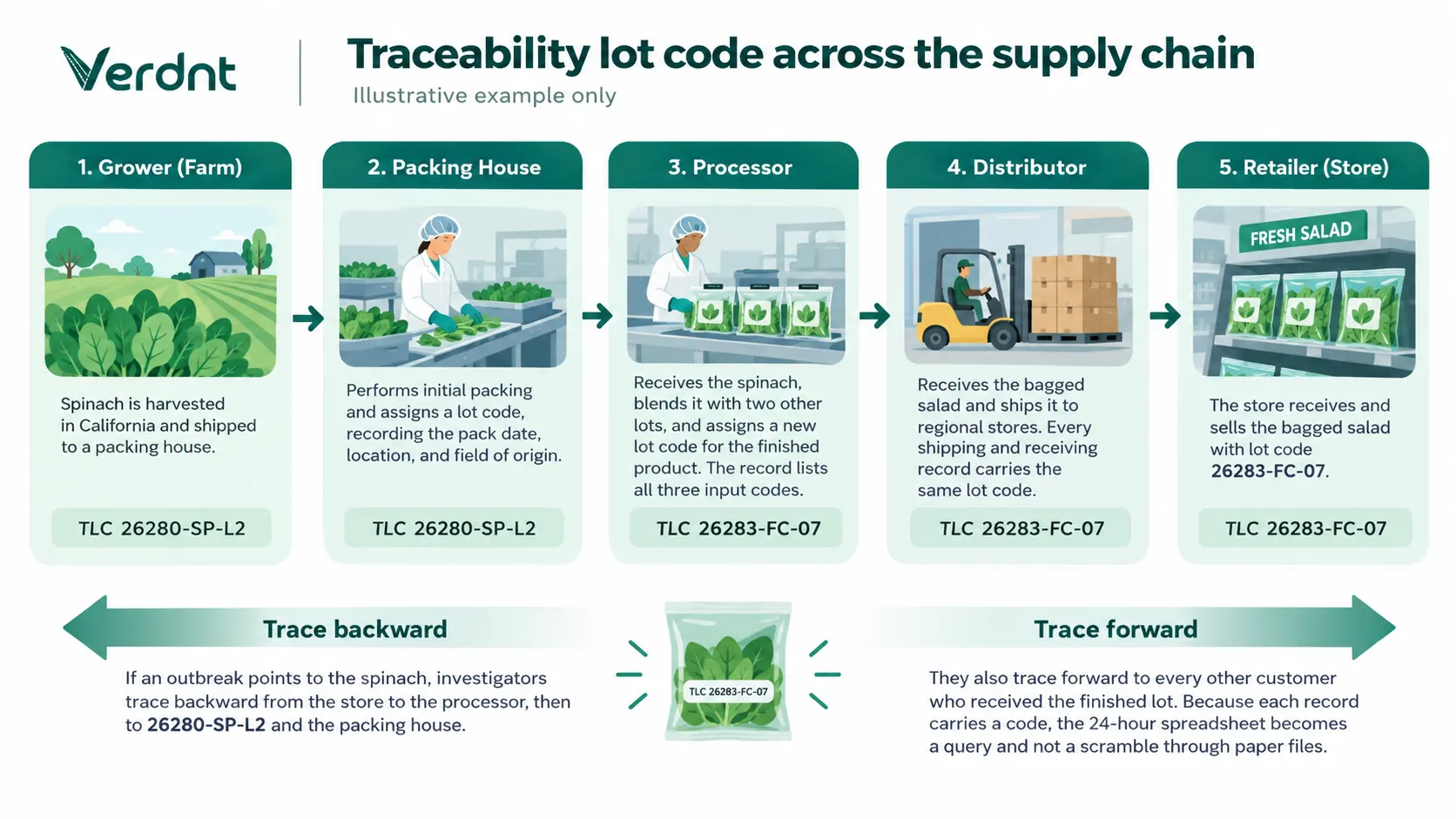
A processor receives the packed spinach and logs the code on its receiving record. It blends this lot with two others, bags the mix, and assigns a new TLC, 26283-FC-07, for the finished product. The transformation record lists all three input codes.
A distributor receives the bagged salad and ships it to regional stores. Every shipping and receiving record carries 26283-FC-07.
If an outbreak points to the spinach, investigators trace backward from a store to the processor, then to 26280-SP-L2 and the packing house, and forward to every other customer who received the finished lot.
And because each record carries a code, the 24-hour spreadsheet becomes a query and not a scramble through paper files.
Common mistakes with lot codes
Recalls tend to expose the same handful of errors. Lot codes get overwritten at a distribution center when a new label is applied. Transformation records capture the output code but omit the input codes, which breaks the backward trace. Suppliers send codes in different formats, and receiving staff retype them with typos. Some teams assign codes to lots that never needed one, which clutters records without helping FDA.
A fifth problem is storing the code in one system and the KDEs in another with no shared key. When a plant keeps its production records in one tool and its shipping records in a spreadsheet, assembling a complete picture takes days. FDA accepts paper or electronic records, but the 24-hour clock does not change with the medium.
Managing lot codes at enterprise scale
Spreadsheets may work for a handful of facilities, but managing lot codes across dozens of locations and hundreds of suppliers requires a more connected approach. Businesses need a system that standardizes lot identification, captures Key Data Elements (KDEs) at Critical Tracking Events (CTEs), and maintains traceability as products move through the supply chain.
This is where platforms like Verdnt become valuable. Rather than managing lot records in isolation, Verdnt connects farm-level data, supplier information, inventory, and operational records in one system. This gives teams better visibility into lot movements, reduces the need to reconcile disconnected records, and makes it easier to retrieve information for audits, compliance checks, and traceability investigations.
With lot-level information connected across operations, food safety teams can trace product movements and investigate issues without piecing together records from multiple systems. Schedule a demo with our team to see how this works across your supply chain.
Conclusion
A traceability lot code is assigned at three points only: initial packing of a raw agricultural commodity, first land-based receiving of a vessel-caught food, and transformation.
Everywhere else, the same code should carry forward with the product and stay linked to each required record. Teams that define ownership, standardize format, and test retrieval before July 2028 will be in a much stronger position to meet the rule and run faster recalls.
If you are mapping that process now, Verdnt can help you connect lot creation, transformation, and audit-ready reporting in one workflow.
Manage Better. Track Everything.
Verdnt brings farm management and traceability together in one platform, giving your team the visibility and data needed to manage operations with confidence.
Frequently asked questions
Is a lot number the same as a traceability lot code?
No. A lot number often identifies a batch inside one plant. A traceability lot code is assigned at initial packing or transformation and must stay linked to shipping and receiving records across companies.
Who assigns a traceability lot code?
The entity that initially packs a raw agricultural commodity, makes the first land-based receipt of a food from a fishing vessel, or transforms a food. FDA notes that initial packers, not growers, are best placed to assign it.
Does the traceability lot code change when food is shipped or received?
No. The code stays the same through shipping, receiving, and storage. It changes only when the food is transformed, which creates a new lot.
Does FDA require a specific lot code format?
No. FDA lets firms choose their own method, such as a Julian date plus product code or a random string, as long as the code uniquely identifies the lot and is explained in the traceability plan.
Can a distributor assign a new traceability lot code?
A distributor should not create a new traceability lot code just because product was shipped, received, or stored. A new code is assigned only at initial packing, first land-based receiving of food from a fishing vessel, or transformation, and a distributor may assign one at receiving only when an exempt supplier did not provide one and the rule requires it.
Can an existing lot number serve as the traceability lot code?
Yes, in many cases it can, as long as it uniquely identifies the traceability lot, stays consistent across required records, and is documented in the company’s traceability plan.
When does the FDA Food Traceability Rule take effect?
The original compliance date was January 20, 2026. Current planning commonly references July 20, 2028, but teams should confirm the latest FDA guidance before finalizing compliance timelines.
Written by
Founder and CEO - Verdnt
Vinay Nair is the Founder and CEO of Verdnt, an enterprise agri-tech SaaS platform that helps agricultural businesses integrate data from tractors, sensors, satellites, weather stations, and mobile applications. His experience building and scaling technology for the agriculture sector gives him first-hand expertise in agri-tech, farm data management, digital transformation, sustainability, and enterprise software. Vinay regularly shares insights on how data and AI can help agricultural businesses improve productivity, strengthen supply chain traceability, and make better operational decisions.
RELATED READS

Crop Management Software for Multiple Farms and Blocks: What to Look For
Vinay NairNov 25, 2026
Best Farm Management Software for Multi-Site Operations (2026): 8 Platforms Compared
Vinay NairNov 24, 2026
What Should a Traceability System Do at the Farm Level? 9 Must-Have Capabilities
Vinay NairNov 22, 2026