Quick Look:
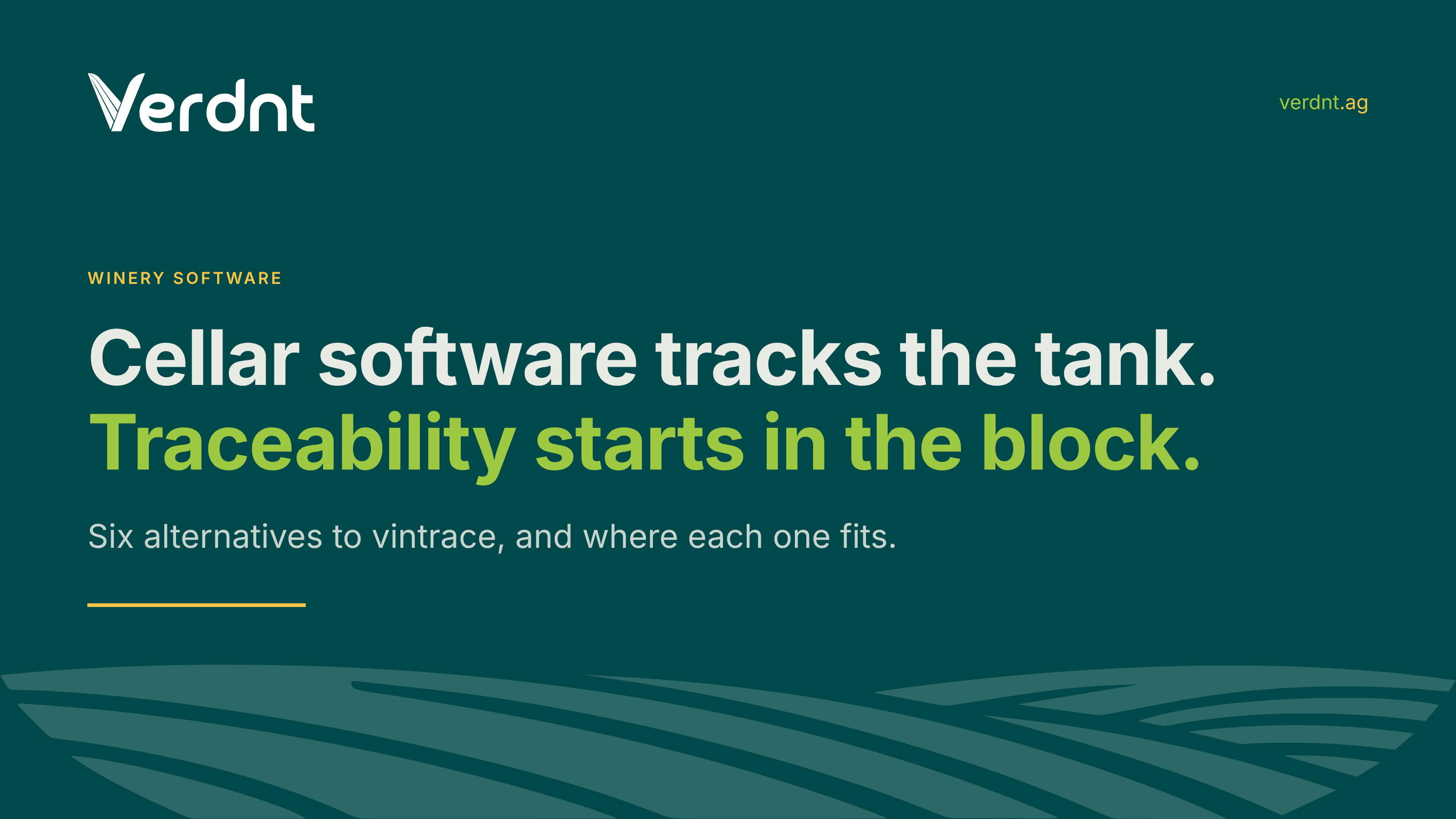
The main alternatives to vintrace for wine production tracking are InnoVint, Orion Wine Software, Ekos, Vinsight and Oracle JD Edwards EnterpriseOne Grower and Blend, with vineyard-to-bottle traceability platforms such as Verdnt covering the block and grower side. The right choice depends on winery size, how much fruit comes from outside growers, whether you need ERP and accounting in the same system, and how far back into the vineyard your traceability has to reach.
The alternatives to vintrace for wine production tracking fall into three groups: cellar-focused winery production systems, craft beverage ERPs that handle wine alongside other drinks, and enterprise or agricultural platforms that start in the vineyard. vintrace itself is a cloud winery production system now owned by Encompass Technologies, and it is a strong benchmark for any comparison.
A winery usually starts looking at alternatives for one of a few reasons: a move to a full ERP, a merger that brings two systems together, a need for deeper vineyard and grower data, or a mismatch between the software's scope and the size of the operation. Naming the reason first keeps the evaluation focused on the right shortlist.
Where vintrace stands today
vintrace covers core winery operations, including fruit intake, work orders, traceability, lab data, barrels, tanks and dispatch, according to its Capterra profile. Encompass Technologies, a food and beverage ERP and data provider, acquired vintrace in 2022, when it served more than 670 wineries.
In March 2025, vintrace acquired eVineyard, a vineyard management system serving about 100 organizations and 1,300 vineyards, to connect vineyard data with winery production. Any alternative should be compared against that combined scope, not the vintrace of a few years ago.
How to compare winery production software
Compare systems on the jobs your team does every week, then on the records your auditors and regulators ask for.
| Criterion |
What to check |
| Cellar operations |
Work orders, vessel and barrel tracking, lab data, mobile entry |
| Compliance reporting |
TTB Report of Wine Premises Operations (5120.17) support, audit trails |
| Blend traceability |
Source percentages carried through every movement and blend |
| Vineyard and grower data |
Block IDs, grower contracts, intake linked to block and pick date |
| Business systems |
Inventory, costing, sales and accounting, built in or integrated |
| Fit for your scale |
Single estate, multi-site group or enterprise producer |
Manage Better. Track Everything.
Verdnt brings farm management and traceability together in one platform, giving your team the visibility and data needed to manage operations with confidence.
The main vintrace alternatives
Each of the systems below appears regularly on winery shortlists. The descriptions use each vendor's or reviewer's published information, so confirm current scope in a demo.
InnoVint
InnoVint is a cloud winery operating system that its listing says is used by more than 2,000 wine brands, with 5120.17 report generation and audit trails, according to SourceForge. It is the most common head-to-head alternative to vintrace, and G2 names it the top overall vintrace alternative.
Best fit: small to mid-size wineries that want a production-first system with strong mobile cellar entry.
Orion Wine Software
Orion combines several products, including Blend, WIMS, WiPS and DarWine, and describes more than 25 years in the wine industry and more than 300 winery customers, per its SourceForge listing. Its suite spans production and the business side of a winery.
Best fit: established wineries and distributors that want production, inventory and sales from one vendor.
Ekos
Ekos serves craft producers with inventory, production, sales, accounting and compliance in one system, according to its Capterra profile. It covers breweries, cideries and distilleries as well as wineries.
Best fit: producers that make more than one beverage type and want one business system across them.
Vinsight
Vinsight is web-based software for food, cider and wine producers to make, cost, count and sell their products, per its Capterra listing.
Best fit: smaller producers that want costing and inventory alongside production in a lighter-weight tool.
Oracle JD Edwards EnterpriseOne Grower and Blend
G2 lists Oracle JD Edwards EnterpriseOne Grower and Blend among the vintrace alternatives. It sits inside a large enterprise ERP suite.
Best fit: large wine companies already running JD Edwards, where a module inside the existing ERP matters more than a specialist tool.
Comparison at a glance
| System |
Primary focus |
Typical buyer |
| vintrace |
Cloud winery production, now with eVineyard vineyard data |
Boutique to enterprise wineries |
| InnoVint |
Winery production operating system |
Small to mid-size wineries |
| Orion Wine Software |
Winery production and business suite |
Established wineries and distributors |
| Ekos |
Craft beverage business management |
Multi-beverage craft producers |
| Vinsight |
Production, costing and inventory |
Smaller producers |
| JD Edwards Grower and Blend |
Enterprise ERP modules |
Large companies on JD Edwards |
| Verdnt |
Vineyard block to blend traceability and agricultural ERP |
Wine groups with many blocks or grower sources |
Where cellar software stops
Cellar systems are designed around vessels and work orders. They track what is in each tank and barrel, and most can trace a bottle back to the lots in its blend. The harder questions start upstream: which vineyard block, picked on which date, under which spray program, supplied each lot, especially when fruit comes from contracted growers rather than estate blocks.
Those questions decide whether varietal, appellation and vintage claims can be substantiated, and whether a sustainability audit can find practice records by block. Our guide to grape-to-glass traceability walks through the records and the label thresholds involved.
Where Verdnt fits
Verdnt is not a cellar work-order system and does not replace the production reporting a dedicated winery tool provides. It covers the vineyard and grower side of the chain and the operations around it. Each vineyard block gets a unique ID, field activity is captured on mobile observation sheets, grape intake integrates weighbridge data and quality checks, and quality based lots are assigned to blending batches so each batch keeps its link to source blocks.
In a 6,500-acre vineyard deployment, that approach produced 100 percent farm to bottle genealogy through blending and bottling. Verdnt also includes agricultural ERP for inventory, purchase, sales and finance, which suits wine groups that buy fruit from many growers. Many wineries will run it alongside a cellar system rather than instead of one. See the agri supply chain traceability page for detail.
Where to start
List the three questions your current system cannot answer quickly, such as which blocks are in a bottled lot, how much grower fruit went into a blend, or where last season's spray records live. Take those questions into every demo and ask each vendor to answer them with your data. The questions to ask a traceability vendor guide covers the security and contract questions to add.
Discover a smarter way to manage farms, data, and traceability.
See how Verdnt can help you gain better visibility across your farm operations and make more informed decisions.

 Vinay NairNov 25, 2026