Quick Look:
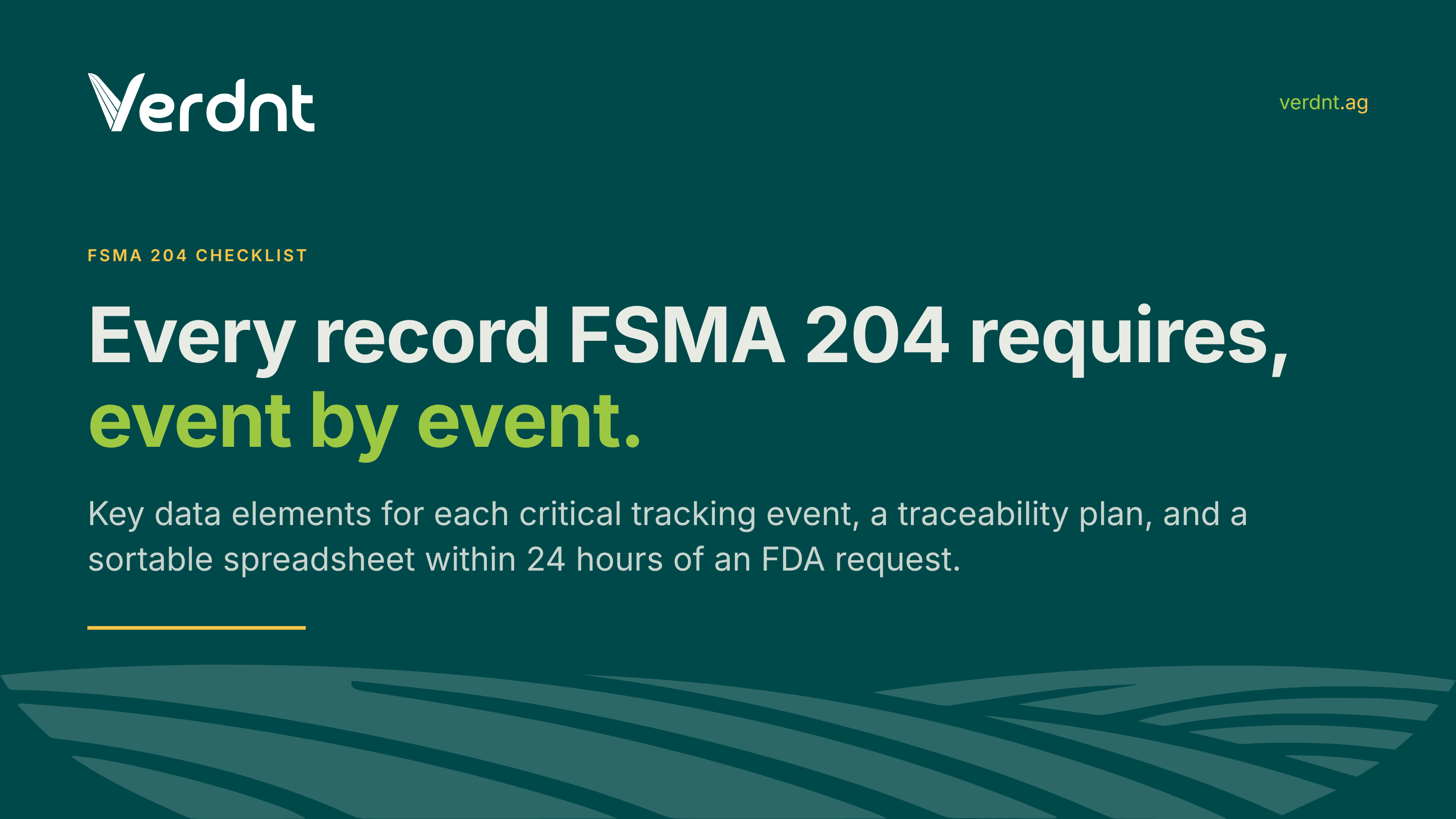
FSMA 204 requires companies that manufacture, process, pack, or hold foods on the Food Traceability List to keep key data elements for each critical tracking event, linked to traceability lot codes. This checklist sets out the core records, CTE and KDE requirements by supply chain role, the records companies often miss, and how to make them audit-ready.
FSMA 204 requirements come down to one practical test: can your company show what happened to a covered food, at the right event, with the right lot code, fast enough for an FDA traceback request?
For companies that manufacture, process, pack, or hold foods on the Food Traceability List, FSMA 204 requires records containing Key Data Elements, or KDEs, for the Critical Tracking Events, or CTEs, they perform. Those events include harvesting, cooling before initial packing, initial packing, first land-based receiving of food from a fishing vessel, shipping, receiving, and transformation.
The FDA states that covered records must be made available within 24 hours of request, or within another reasonable timeframe agreed to by the agency.
This guide is an operational checklist, not legal advice. For the full rule context, start with our guide to the FSMA 204 traceability rule, then use this article to map the records your teams, growers, suppliers, and facilities need to capture.
FSMA 204 recordkeeping requirements at a glance
The simplest way to understand FSMA 204 is to separate scope from records. First, confirm whether your business handles a food on the Food Traceability List. Then identify which CTEs your organization performs. After that, map the KDEs required for each event and make sure those records are linked to the relevant traceability lot code where applicable.
The FDA’s rule applies across the farm-to-table supply chain, including domestic and foreign firms producing food for U.S. consumption. It allows records to be maintained as original paper records, electronic records, or true copies, provided they are legible and stored to prevent loss or deterioration.
Covered FSMA 204 records generally must be kept for two years from the date they are created or obtained. Companies should also be able to provide FDA food traceability records within 24 hours of a request, or within another reasonable timeframe agreed to by FDA, and should test whether they can produce an FSMA 204 sortable spreadsheet when required during an outbreak, recall, or public-health threat situation..
| Requirement area |
What to document |
Operational owner |
| Product scope |
Which Food Traceability List foods and covered ingredients are handled |
Compliance and QA |
| Events |
Which CTEs occur in each product workflow |
Operations and supply chain |
| Data fields |
KDEs required for each event |
QA, operations, and data owners |
| Lot linkage |
Traceability lot codes and parent-child lot relationships |
Packing, production, and traceability teams |
| Records access |
Retrieval, export, audit trail, and record location |
IT, compliance, and data governance |
A useful rule of thumb: if a record cannot be connected to a product, event, date, location, party, and lot relationship, it may not help during a real traceback.
Core records every covered company should prepare
Before building event-level forms, companies should prepare a few foundational records. These are not always the most visible records in day-to-day operations, but they determine whether CTE and KDE data can be interpreted later.
| Core record |
What it should clarify |
Why it matters |
| Traceability plan |
How required records are maintained, where they are stored, how FTL foods are identified, how lot codes are assigned, and who owns traceability questions |
The FDA identifies the traceability plan as a required element for covered entities |
| FTL applicability map |
Which commodities, ingredients, product forms, and locations may be in scope |
Prevents teams from treating all products the same or missing covered ingredients |
| Location master data |
Facility names, addresses, farms, fields, growing areas, cooling sites, warehouses, and trading partner locations |
Location descriptions are recurring KDEs across multiple events |
| Product master data |
Commodity, variety, product description, pack style, SKU, ingredient form, and unit of measure |
Product descriptions must be consistent enough to support traceback |
| Traceability lot code rules |
When a TLC is assigned, preserved, translated, or connected to a new output lot |
Lot-code discipline prevents broken traceback chains |
| Reference documents |
Bills of lading, packing slips, invoices, batch sheets, harvest logs, receiving logs, and ASN references |
Reference document type and number often prove where supporting evidence lives |
| Access and change history |
Who entered, edited, approved, exported, or transmitted records |
Auditability depends on control, not just data storage |
For covered growers or farms that raise or grow Food Traceability List foods other than eggs, the traceability plan must also include a farm map showing the location and name of each field or growing area, including geographic coordinates and other information needed to identify the location. This is where grower onboarding, farm mapping, and field-level data become compliance infrastructure.
CTE and KDE checklist by role
Exact KDE obligations vary by CTE, commodity, product form, exemption status, and the activity your organization performs. Treat the checklists below as an operational readiness map. Your final compliance procedures should be verified against FDA guidance and your legal or regulatory advisors.
Growers and harvesters
Harvest records are the first-mile evidence layer for many agricultural supply chains. If the field, grower, harvest date, and product identity are inconsistent, every downstream record becomes harder to trust.
| Record field to verify |
What teams should capture |
| Grower and farm identity |
Grower ID, farm ID, business name, contact, and responsible operator |
| Harvest location |
Farm location, field or growing-area name, and location description |
| Field evidence |
Geographic coordinates or mapped field data where required or operationally useful |
| Product identity |
Commodity, variety, product description, and covered-food status |
| Harvest timing |
Harvest date, or start and end dates for multi-day harvests |
| Quantity context |
Quantity and unit of measure where captured at harvest or handoff |
| Harvester details |
Harvester company, crew, responsible person, and contact where applicable |
| Handoff record |
Initial packer, cooler, or immediate subsequent recipient information |
| Lot linkage |
Connection to the traceability lot code once assigned downstream |
This is also a grower onboarding problem. A harvest checklist works only if grower, farm, field, and commodity records have already been standardized.
Coolers before initial packing
Cooling before initial packing is a formal CTE under the rule. It often sits between field activity and initial packing, so it needs to preserve the source context instead of creating a data gap.
| Record field to verify |
What teams should capture |
| Product and source |
Commodity, incoming harvest reference, grower, field, or lot context |
| Cooling location |
Facility, cooling site, or location description |
| Cooling timing |
Cooling date and, where operationally relevant, time or batch window |
| Quantity context |
Quantity and unit associated with the cooled product |
| Handoff |
Initial packer or subsequent handling location |
| Linkage |
Connection back to harvest records and forward to the traceability lot record |
Operationally, cooling records should not sit in a separate clipboard or spreadsheet that packing teams cannot reconcile. They should connect source, date, location, and quantity before the product enters commercial inventory.
Initial packers
Initial packing is one of the most important recordkeeping points because this is where a traceability lot code is commonly assigned for raw agricultural commodities, excluding food obtained from a fishing vessel. The FDA states that once a food has been assigned a TLC, required records at each CTE must include that TLC and link KDEs to the relevant traceability lot.
| Record field to verify |
What teams should capture |
| Traceability lot code |
TLC assigned to the packed product |
| TLC source or reference |
Location or reference showing where the TLC was assigned |
| Product description |
Commodity, variety, pack style, case details, and unit of measure |
| Quantity |
Quantity packed and relevant unit |
| Packing location and date |
Facility or line where product was packed, plus packing date |
| Harvest context |
Harvest location, field or growing-area name, harvest date, and harvester information |
| Cooling context |
Cooling location and cooling date if cooling occurred before initial packing |
| Reference document |
Packing record, label record, harvest record, or other document type and number |
| Label or case identifiers |
GTIN, case label, barcode, QR code, or other identifiers where used |
This is a critical control point for produce businesses because it connects farm-origin evidence to a lot identity that downstream partners can reference.
Shippers
Shipping records explain where the product went after it left a location. The goal is to preserve lot continuity across the next handoff, not only prove dispatch.
| Record field to verify |
What teams should capture |
| TLC |
Traceability lot code associated with the shipped food |
| Product description |
Product name, commodity, pack size, and relevant identifiers |
| Quantity and unit |
Amount shipped and unit of measure |
| Ship-from location |
Origin location description |
| Immediate subsequent recipient |
Customer, distributor, warehouse, or buyer location, excluding the transporter |
| Ship date |
Date the product was shipped |
| TLC source/reference |
Where the TLC was assigned or the reference used to identify that source |
| Reference document |
Bill of lading, invoice, packing slip, ASN, or shipment document number |
The Produce Traceability Initiative emphasizes supply-chain handoffs and traceability lot code linkage as part of implementation planning for produce supply chains PTI FSMA 204 Implementation Guidance. For enterprise teams, the practical test is whether shipping data can be filtered by lot, date, destination, and document reference.
Receivers
Receiving records complete the other side of a shipment. They should confirm what arrived, where it arrived, when it arrived, and whether the lot and quantity match the supplier’s record.
| Record field to verify |
What teams should capture |
| TLC received |
Traceability lot code provided by the supplier or upstream party |
| Product description |
Product identity and pack details received |
| Quantity and unit |
Quantity received, accepted, rejected, or adjusted |
| Immediate previous source |
Supplier or ship-from business location, excluding the transporter |
| Receiving location |
Facility, warehouse, packing house, or processing site |
| Receiving date |
Date the food was received |
| TLC source/reference |
Source location or reference for the TLC |
| Reference document |
Packing slip, invoice, BOL, ASN, or receiving document number |
| Discrepancy record |
Overages, shortages, damaged product, rejected product, or lot mismatch notes |
Discrepancy records may not always be listed as a formal KDE, but they are operationally important. They help explain why received quantity differs from shipped quantity and whether the lot remained suitable for downstream movement.
Transformation is where traceability often breaks. When a food is cut, mixed, repacked, relabeled, or processed into a new covered output, the company needs to preserve the relationship between input lots and output lots.
| Record field to verify |
What teams should capture |
| Input TLCs |
Traceability lot codes for each input food used |
| Input product descriptions |
Product identity for each input lot |
| Input quantities consumed |
Quantity and unit used from each input lot |
| Output TLC |
New traceability lot code assigned to the transformed food |
| Transformation location |
Facility, line, or location where transformation occurred |
| Completion date |
Date transformation was completed |
| Output product description |
Description of the transformed food, pack style, and unit |
| Output quantity |
Quantity produced and unit of measure |
| Reference document |
Batch sheet, production record, repack record, or transformation document number |
| Lot genealogy |
Parent-child relationship between input lots and output lots |
| Exception notes |
Rework, commingling, repack, relabeling, hold, or quality disposition notes |
From an operational standpoint, parent-child lot genealogy protects recall precision. Without it, companies may be forced to widen the scope of a recall because they cannot prove which output lots used which input lots.
First land-based receivers for fishery foods
First land-based receiving is a specific CTE for food obtained from a fishing vessel. Even if it is not relevant to most agricultural enterprises, it matters for seafood supply chains and mixed portfolios.
| Record field to verify |
What teams should capture |
| Receiving location |
First land-based location taking possession |
| Product description |
Species or product identity and form |
| Source context |
Vessel, harvest, container, or source information as applicable |
| Date received |
Date of first land-based receipt |
| Quantity and unit |
Amount received and unit of measure |
| TLC assignment |
Traceability lot code assigned where required |
| TLC source/reference |
Location or reference associated with TLC assignment |
| Reference document |
Landing record, receiving record, invoice, or other document number |
Companies that handle both produce and seafood should avoid a single generic FSMA form. The record model must reflect the event type.
Simplify FSMA 204 Food Traceability
See how Verdnt can help your team manage FSMA 204 traceability requirements with greater visibility and confidence.
The FSMA 204 records companies often miss
Most companies do not fail traceability because they have no records. They fail because the records do not connect.
The first commonly missed record is the TLC source or source reference. A lot code is useful only if teams can identify where it was assigned and how it links back to source records. The second gap is field or growing-area identity. “Farm A” may not be enough when multiple fields, blocks, harvest crews, or crop varieties are involved. The third gap is the reference document number. During a traceback, “packing slip” is less useful than “packing slip PS-10482.”
Transformation records are another weak point. Many systems store inbound lots and finished goods separately, but do not preserve the input-to-output relationship with enough clarity. Exempt-supplier scenarios can also cause confusion, especially when incoming product arrives without a TLC. The FDA states that if an FTL food is received from an exempt entity and no TLC has been assigned, the receiver may need to assign one unless it is a retail food establishment or restaurant.
The final gap is export readiness. A record may exist in a binder, an email, a PDF, and an ERP note, but if no one can assemble the relevant CTEs and KDEs quickly, the traceability program is still fragile.
How to make FSMA 204 records audit-ready
A practical FSMA 204 record readiness approach should connect seven layers: product scope, partner and location master data, event records, lot-code relationships, reference documents, export readiness, and audit governance. These layers reflect how the rule moves from “which covered foods do we handle?” to “can we retrieve connected, lot-level records quickly during a traceback request?”
Teams must know whether the food is in scope, who handled it, what event occurred, which lot connects the event, which document supports the record, whether the record can be exported, and who controlled the data.
Audit-ready FSMA 204 records need more than a final spreadsheet. They need standardized digital forms for each CTE, required-field validation, controlled product and location names, role-based access, change history, and clear lot-code rules. They also need connections between farm operations, procurement, packing, ERP, inventory, quality, logistics, and sustainability systems.
Mock traceback exercises are the best test. Select a lot, retrieve the harvest or receiving record, follow the lot through packing, transformation, shipping, and receiving, then export the relevant data in a usable format. If the exercise requires manual reconstruction across five systems, the issue is not only compliance. It is data architecture.
Verdnt helps agricultural enterprises turn farm, supply-chain, ERP, and sustainability data into connected traceability workflows. That matters because FSMA 204 readiness starts where the data starts: with growers, fields, facilities, events, lots, and partner handoffs.
FSMA 204 records checklist for internal teams
| Team |
Readiness checklist |
| Compliance and QA |
Confirm covered foods, exemptions, traceability plan ownership, applicable CTEs, and record retention requirements. |
| Operations |
Map harvesting, cooling, packing, shipping, receiving, and transformation workflows against the records each team captures. |
| Grower and supplier management |
Standardize grower profiles, supplier master data, field records, certifications, location descriptions, and data handoff expectations. |
| IT and data teams |
Validate system fields, integrations, audit trails, user permissions, searchable records, and sortable spreadsheet export capability. |
| Leadership |
Fund the program as traceability infrastructure, not a one-time compliance document, and require mock traceback performance reporting. |
This is the practical difference between having records and having traceability. Records are files. Traceability is the connected story those files can tell under pressure.
Final takeaway
FSMA 204 requirements are about connected records across events, lots, locations, documents, and trading partners.
For agricultural enterprises, the highest-value work happens before the FDA or a buyer asks for proof. Standardize grower and supplier data. Map CTEs. Define lot-code rules. Digitize field, packing, shipping, receiving, and transformation records. Test exports before a real incident.
See how Verdnt helps agricultural enterprises turn farm, supply-chain, ERP, and sustainability data into audit-ready traceability workflows.
Discover a smarter way to manage farms, data, and traceability.
See how Verdnt can help you gain better visibility across your farm operations and make more informed decisions.


 Vinay NairNov 25, 2026